
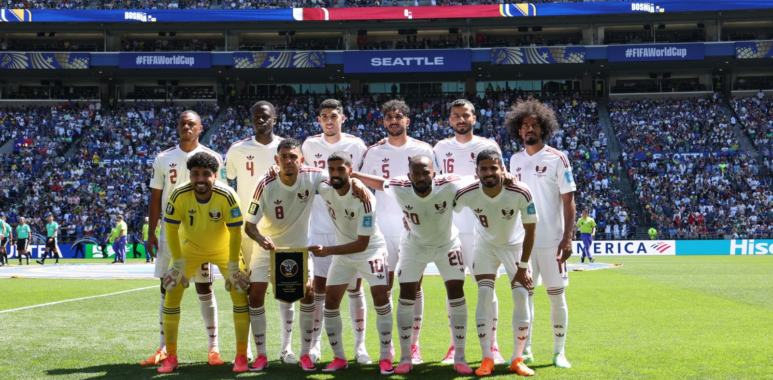
Qatar’s World Cup ends with Bosnia defeat but bigger questions await
Akram Afif had come out of a self-imposed Instagram exile that lasted more than four years. One of the stories he posted was an AI-generated image of himself carrying a heavy stone, the QFA crest stamped on it with the kind of symbolism that does not require much explanation. Another, with his photo and the message presumably meant for himself as much as for anyone watching, read simply: “Yesterday will not be repeated. Today is an opportunity. Tomorrow is a dream.”
By the time the final whistle sounded at Lumen Field, it was difficult not to notice how literally that sentiment had been tested, and how unevenly it had held up. The only yesterday that repeated, in the end, was Hassan Al-Haydos. The opportunity, albeit fleeting and ultimately bygone, arrived and left in the form of a Pedro Miguel shot that clattered off the post when the scoreline still felt salvageable. The dream, whatever shape it takes, will have to wait for a rebuild and another World Cup.
Bosnia won, 3-1, a result that keeps their own hopes of qualifying as one of the better third-placed sides comfortably alive. Qatar managed promising spells, here and there, in the way that many will believe should have been the approach from the first minute. None of them, however, amounted to enough.
After all, Julen Lopetegui had made four changes to the side beaten in Vancouver, two of them not really choices at all. Assim Madibo and Homam Al-Amin were both suspended after receiving red cards against Canada. Karim Boudiaf was given his first start of the tournament and so was Sultan Al-Brake. And Qatar, as they had against Canada, found themselves in the same vulnerability surfacing again before there had been any real opportunity to address it.
The threat had been coming for Qatar. The Bosnians had kept trying Mahmoud Abunada from the get-go, the rousing Qatari keeper tested from outside the box twice came within the opening three minutes. Third time was the charm, and it was the lauded teenager Kerim Alabegovic who struck it sweet. Abunada’s full-stretch, this time around, did not stand a chance.
A scrappy one then followed the screamer as Qatar were two down from the wave that swept after the hydration break. Al-Brake’s attempt at a clearance ended up in Qatar’s near post off 40-year-old Edin Dzeko’s half-volley. The last of a handful of sequences that Bosnia strode forward ahead of the half ended with Dzeko striking the far post.
It then felt like recent history would repeat for Qatar. A promising start had started to falter against Canada too, and that was when Al Annabi’s drubbing realistically started in Vancouver. Instead, in a surprising turn of events, Lopetegui took the handbrake off, and Al-Haydos did not miss. In what were the side’s first two touches inside the opposition box, Edmilson set the Qatari captain up from close range.
Half-time could not have come at a worse time for the Maroons, who perhaps looked genuinely threatening for the first time in the tournament, almost every time they ran forward. Pedro’s shot thundered off with just a minute left to play of the added five.
However, it brought back obvious questions that the Qatar head coach has faced, particularly in this tournament. Freeing the shackles seemed to galvanize the side, at least for some good 15 minutes and it was Afif who was the most involved, yet not the most efficient, mostly because he was still the one who had to create and finish. Starting Al-Haydos after the failed experiment with Yusuf Abdurisag on the wing helped, but a striker’s presence in the box definitely would have helped more.
The changes that followed in the second half told their own story. Jassim Jaber, battered for much of the afternoon by a Bosnian midfield that had found him early and kept finding him, was withdrawn for Abdulaziz Hatem. Al-Haydos followed him off ten minutes later, replaced by Ganehi, the captain’s second act that had seen him come out of retirement, rewarded with a World Cup goal.
A chance then fell to Afif somewhere in between, the kind of half-opening he has made a career of finishing, and this time it did not go in. The critics were handed another reason to repeat what has been against him: perhaps the World Cup really is the ceiling that Qatar’s greatest player has never quite been able to clear.
By the time Almoez Ali entered, Qatar’s all-time leading scorer and as reliable a tournament player as the country has produced, the game had largely moved beyond saving. Ermin Mahmic’s strike with ten minutes left on the clock confirmed as much. Qatar’s tournament had ended before they had finished playing it out.
It is hard to escape the sense, watching the afternoon unfold, that this defeat said less about one afternoon than about everything that led to it.
There was a version of Qatari football, not so long ago, that was often held up as a model. A project built patiently from the grassroots in Aspire, one that promised to eventually outgrow its reliance on naturalisation, to produce enough of its own that it would no longer need to borrow. Whatever chapter that promised and represented, closes here. The two Asian Cups feel like a long time ago now, belonging to a different iteration of this team entirely.
What comes next will likely have to be an overhaul and not a tweak, unlike the one that followed the home World Cup in 2022. The only way it will be measured will be the next time Qatar are made to stand across from the best teams in the world, and whether they will make it the next time around. Tomorrow, then, is an opportunity.
