
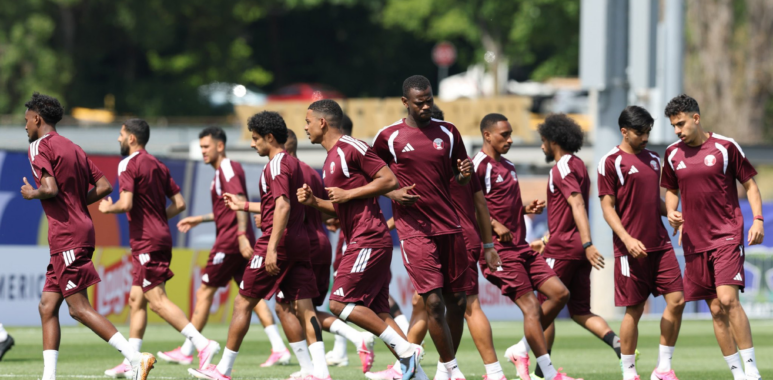
After Vancouver, Qatar must find a way forward
The build-up to Qatar’s last group game of the 2026 World Cup, against Bosnia & Herzegovina, has been understandably tense.
While the recent history of the national team has been nothing short of a confusing rollercoaster ride, this particular instance stands out. How do you go from earning the country’s first-ever point at the World Cup, to a psychologically damaging disaster in the next game? And then, you are told: let’s have another go, we have one more chance left.
One thing that sets this World Cup apart from the ones that came before it is the number of rest days between games. From that perspective, we can hope Julen Lopetegui’s Qatari team has had enough time to process the 6-0 defeat to Canada.
Looking back, it’s almost strange when you realise Qatar was not particularly bad in the opening 15 minutes leading up to Canada’s first goal, which changed things. The little strains of pressure we noticed during the opener against Switzerland became more and more evident on the players’ faces. And then came the second goal, followed by the red card to Homam. From there, the disaster unravelled in front of our eyes.
By the time Assim Madibo was sent off following his tackle on Ismaël Koné, there seemed to be nothing left in the Qatari players. Young substitute Mohammed Manai inadvertently getting his name on the scoresheet with an own goal summed up the day’s events in brutal fashion.
As much as I have tried to forget everything, those images and that scoreline still pop up for me – a mere observer from thousands of miles away. But what would it have meant for the players of Al-Annabi on that Thursday evening in Vancouver?
It is easy to stand up in front of a microphone and say “we need to turn the page”, but the actual act of turning often turns out to be heavier than expected. That is the first and most immediate challenge that Lopetegui will have had to deal with.
However, when you try to look beyond that wall, you see another complicated question staring at you.
How are you going to score?
Thankfully for Qatar, the objective is clear: defeat Bosnia. While there is a possibility that goal difference may still come to haunt them, a win by any result today will be a huge step towards the knockout stage. Just get that win and it probably should be enough.
So straightforward, and yet so distant.
Qatar’s record in 2026 so far reads: four games, two draws, two defeats, one goal scored and eight conceded. If you look at Lopetegui’s record overall, the team has only scored nine goals in 15 games during his tenure. The prospect of a win over a stronger Bosnian side looks increasingly bleak the further you look at the stats.
Beyond the numbers, the sticking point is the approach taken by Lopetegui, which left us all frustrated. The result against Switzerland owed much to the opponents being uncharacteristically wasteful up front, combined with an inspired showing by Mahmoud Abunada between the sticks for Qatar. The scoreline should not have masked the fact that Qatar posed barely any threat going forward. We couldn’t blame Akram Afif for this; he did not have a midfield that was interested in the same mission.
The move that led to Qatar’s equaliser turned out the way it did because it began and ended with Khoukhi Boualem’s intervention in the opposing half. The fact that we had to rely on our 35-year-old ‘versatile’ centre-back for that said plenty, but it seemed the coach did not notice what everyone else did. He duly went on and selected the exact same XI for the game against Canada.
Our neighbours Saudi Arabia had a similar set of results: drawing 1-1 against Uruguay in the opening game before going down 4-0 to Spain. Considering the format of the tournament and the fact that the Saudis could still qualify with a win over Cabo Verde, I saw someone on X ask a very pertinent question: if the result in the second game was inconsequential, why bother setting up so defensively in it?
It is the same question that Lopetegui should be answering. He has in his squad players who have been brave against better sides in tournaments across the world – Asian Cup, Copa America, Gold Cup.
The unavailability of Madibo and Homam means that Lopetegui will make two changes, at the very least. Every Qatari follower who still has hope in this team will expect the coach to make more than two. Stop the Yusuf Abdurisag experiment, start with Karim Boudiaf, play Issa Laye in defence, and make use of Ahmed Al-Ganehi. This is almost the consensus of fans and pundits, but if Lopetegui begs to differ, we may all be wallowing in the same well of despair that we found ourselves in after the Canada game.
Can we dream, Mr. Lopetegui?
This is the moment to be bold, to take the steps needed to unleash the magic of Afif, to start the game with a midfield that can actually help us do that. This is what the team needs, and this is what the coach should be focused on.
Because it’s the only way we can really “turn the page” on one of the darkest chapters in Qatar’s footballing history.
